

After nearly eight months in orbit, four astronauts are about to close the hatch. NASA’s SpaceX Crew-12 plans to undock from the International Space Station on Wednesday, Oct. 7, at 7:05 a.m. CT. If that holds, they splash down off California on Thursday, Oct. 8, at about 10:34 a.m. CT.
NASA locked in the full coverage schedule in a media advisory Monday. Weather still has the final say. Mission managers keep watching conditions in the Pacific recovery zone. Undocking depends on spacecraft readiness, recovery team readiness and the forecast off the California coast.
So here’s what to watch, and why this homecoming is a big one.
Who’s Coming Home
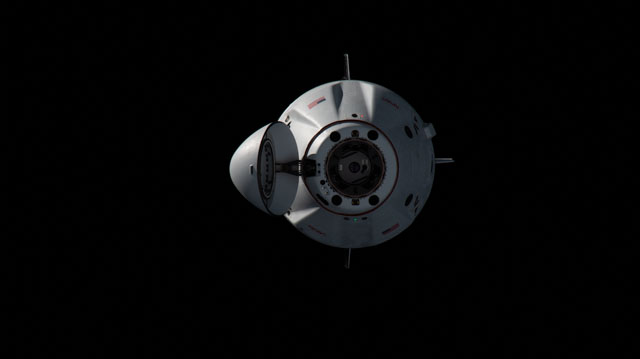
The crew rides Dragon Freedom. NASA astronaut Jessica Meir commands. NASA’s Jack Hathaway is the pilot. ESA astronaut Sophie Adenot of France and Roscosmos cosmonaut Andrey Fedyaev fly as mission specialists.
They launched Feb. 13, 2026, and by splashdown, they will have logged about 237 days in space. That’s well past the typical six-month station stay.
Their exit has been carefully staged. Crew-13 arrived Oct. 1 with commander Jessica Watkins, pilot Luke Delaney, cosmonaut Sergey Teteryatnikov and Canadian astronaut Joshua Kutryk. For a few days, the station held 11 people. Then, on Sunday, Meir handed station command to Roscosmos cosmonaut Pyotr Dubrov.
The crowding got creative. With Crew-13 aboard, Meir gave up her sleeping quarters. She camped out in the docked Dragon that will carry her home.
Wednesday: Hatch Close and Undock
NASA coverage begins early. All times below are CT and can change with real-time operations.
- 5:00 a.m.: Hatch closure coverage begins
- 5:20 a.m.: Hatch closes
- 6:45 a.m.: Undocking coverage begins
- 7:05 a.m.: Undocking
Freedom will back away from the space-facing port of the Harmony module and then a series of burns moves the capsule clear of the station. After the undocking broadcast ends, NASA will carry audio-only communications between the crew, the station and flight controllers.
The crew then spends roughly a day in free flight. They orbit Earth, lining up for their trip down.
Thursday: Fire and Splashdown
Return coverage starts Thursday morning.
- 9:20 a.m.: Return coverage begins
- 9:46 a.m.: Deorbit burn
- 10:34 a.m.: Splashdown off California
The deorbit burn is the point of no return. Dragon fires its engines to slow down and drop into the atmosphere. Reentry gets violent fast. ESA says the capsule faces temperatures as high as 1,600 degrees Celsius. That’s nearly 2,900 degrees Fahrenheit, and Dragon’s heat shield takes the punishment while plasma glows in front of the capsule.
Next, the parachutes open and the capsule settles into the Pacific, while a SpaceX recovery team then hoists Freedom aboard and helps the crew out. For the first time in nearly eight months, they’ll feel full gravity again.
Adenot won’t stay long in California. ESA says she flies to Cologne, Germany, a few hours later. There she starts post-flight checks at the European Astronaut Centre and the nearby :envihab facility.
At 12:15 p.m. CT, NASA hosts a station briefing and will cover the Crew-12 return and SpaceX’s upcoming CRS-35 cargo launch. Speakers include Bill Spetch and Dr. Liz Warren of NASA’s Low Earth Orbit Program, SpaceX senior mission manager Lee Echerd and ESA’s Andreas Mogensen.
A Record-Setting Flight for Europe
This mission has already made history for Europe. ESA calls Adenot’s mission εpsilon. On Sept. 3, she hit 200 straight days aboard the station. That set a new European record for the longest single spaceflight. Luca Parmitano held the old mark with his 200-day Beyond mission. Thomas Pesquet’s 199-day Alpha mission came right behind.
Adenot also broke ground outside the station. She became the first French woman to spacewalk and the second European woman to do it, after Samantha Cristoforetti in 2022. She completed three spacewalks in just 14 days. In total, she logged 19 hours and 42 minutes outside.
She’s only the second French woman ever to fly in space. Claudie Haigneré was the first, 30 years ago in August 1996.
The Science They Bring Home
Long stays are about more than endurance. They’re about data. NASA highlighted some of Crew-12’s research on Monday. The crew studied cancer-targeting treatments, bone loss and regeneration, and antibiotic-resistant bacteria.
Each of those connects to life on Earth. Bone loss in microgravity mirrors osteoporosis, just sped up. Drug-resistant bacteria are a growing hospital problem. Microgravity lets researchers watch cells and microbes behave in ways that are hard to see on the ground.
Adenot’s European work spanned health research, materials science, biology, fluid physics, radiation physics and fundamental science, ESA says. She also helped test a new European exercise device called E4D. And she supported in-orbit metal 3D printing.
That last one deserves a closer look. Printing metal parts in orbit could let future crews make spare parts on demand. That matters a lot more on a trip to the Moon or Mars, where resupply isn’t days away.
Why It Matters
Here’s the bigger picture. Crew-12’s eight months show how routine long-duration flight has become, and how much is still learned from it. Every extra month gives doctors more data on how bodies change in space. Those lessons feed directly into NASA’s plans for Artemis and longer trips beyond Earth orbit.
The handoff also shows the station’s rhythm. One crew arrives, they overlap, then the other heads home. That overlap keeps experiments running without a gap.
Finally, the West Coast splashdown keeps recovery close to SpaceX’s California operations. And it keeps the Pacific busy Thursday. Before dawn that same day, SpaceX plans a Falcon 9 launch from Vandenberg.
How to Watch
NASA will stream coverage across its platforms. ESA Web TV and ESA’s YouTube channel will also carry undocking and splashdown live.
Set your alarm for 5 a.m. CT Wednesday if you want the hatch close. Or sleep in and catch undocking at 7:05 a.m. CT. Then come back Thursday morning to see Freedom hit the water.



