

SpaceX has a busy night ahead. A Falcon 9 is set to launch Starlink satellites from California tonight. Then, before sunrise Tuesday, another Falcon 9 will send a cargo Dragon toward the International Space Station from Florida.
The weather looks friendly for the Florida launch. The Space Force’s 45th Weather Squadron gives the CRS-35 mission less than a 5% chance of a weather violation. That’s about as good as a launch forecast gets.
Tonight: A 20th Flight From Vandenberg
First up is a Starlink mission from Space Launch Complex 4 East at Vandenberg Space Force Base. The launch window runs from 6 to 10 p.m. CT tonight, according to Spaceflight Now and The Grid Fin.
SpaceX says Falcon 9 will carry 27 Starlink satellites to low Earth orbit. Spaceflight Now lists the batch as Starlink 15-25, made up of V2 Mini Optimized satellites.
This mission has waited a while. Spaceflight Now says it slipped from Sept. 30, then from Oct. 10 and Oct. 11. The same pad also hosted the Space Development Agency’s fourth Tranche 1 launch, which flew Saturday at 2:39 a.m. CT on its fourth try.
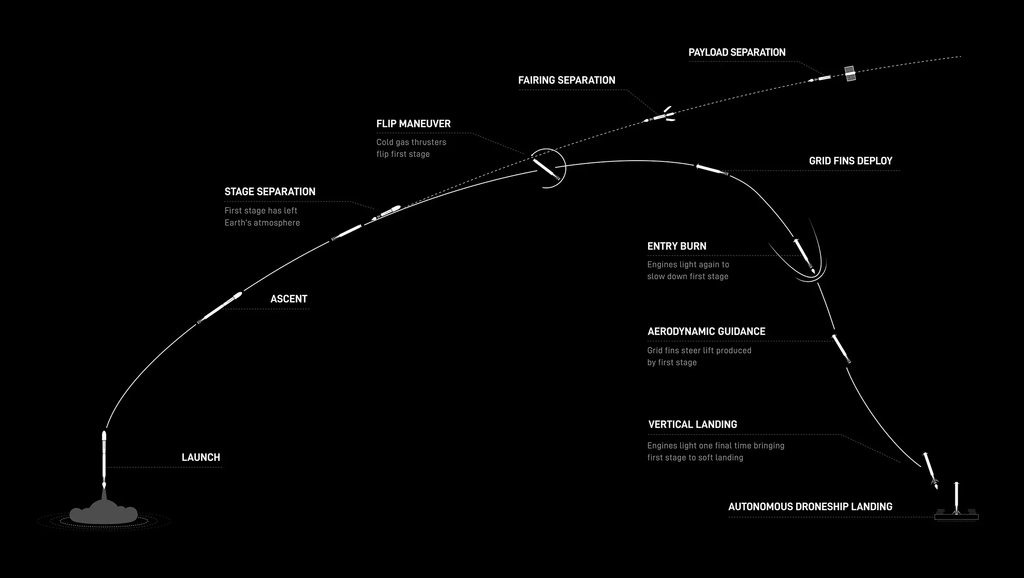
The booster is the headline. SpaceX says this first stage is flying for the 20th time. Its résumé includes NROL-126, Transporter-12, NASA’s SPHEREx telescope, NROL-57, USSF-366 and 14 earlier Starlink missions. Spaceflight Now identifies it as B1088.
The booster should land on the droneship Of Course I Still Love You about eight minutes after liftoff. The satellites deploy about an hour into flight.
SpaceX warns that Santa Barbara, San Luis Obispo and Ventura counties may hear sonic booms. The webcast starts about 10 minutes before liftoff.
Tuesday Morning: CRS-35 Heads for the Station
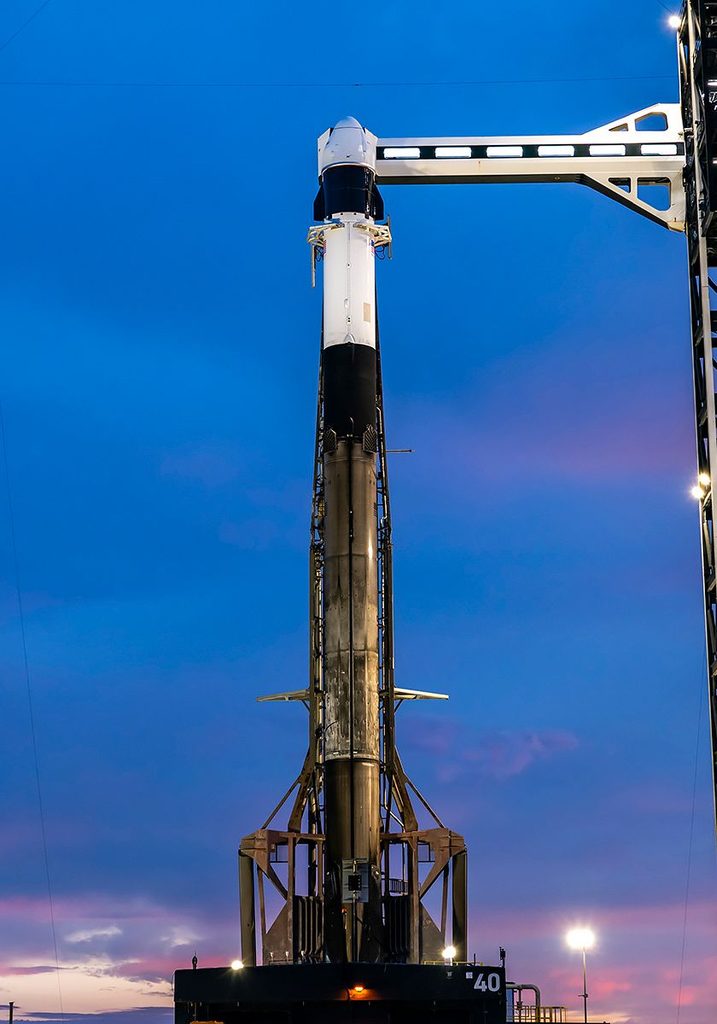
The bigger mission comes next. NASA and SpaceX are targeting 5:33 a.m. CT Tuesday, Oct. 13, for the 35th SpaceX Commercial Resupply Services flight. Falcon 9 will lift off from Space Launch Complex 40 at Cape Canaveral Space Force Station. If needed, a backup opportunity opens Wednesday at 5:08 a.m. CT.
Dragon is packed with more than 6,300 pounds of supplies and science, NASA says. After a roughly 52-hour trip, it should dock on its own to the space-facing port of the Harmony module. NASA puts that docking at about 10 a.m. CT Thursday, Oct. 15.
NASA’s launch coverage begins at 5:15 a.m. CT. Arrival coverage starts at 8:15 a.m. CT Thursday.
A Forecast Launch Teams Dream About
The 45th Weather Squadron issued its CRS-35 launch forecast Sunday at 10 a.m. CT. Forecasters called the odds of weather problems “minimal” for Tuesday and both backup days.
The reason is a cool, dry push of air. The remnants of Isaias are drifting across the eastern U.S., forecasters wrote. That leaves Florida’s Space Coast in “dry northwesterly flow” behind a trailing trough on Tuesday morning. Expect lower humidity, cooler temperatures and few clouds.
Their only stated concern is the cumulus cloud rule. Liftoff winds should blow from the north at 8 to 12 mph. Booster recovery weather is rated low risk.
The odds tick up slightly later in the week. A 24-hour delay brings a 5% chance of violation. A 48-hour delay brings 10%, as winds turn easterly.
A Veteran Dragon Comes Full Circle
Both CRS-35 vehicles have flown before. SpaceX says this is the fourth flight for this cargo Dragon, which previously flew CRS-26, CRS-29 and CRS-33. Spaceflight Now identifies the capsule as C211.
The first stage is on its eighth flight. SpaceX says it previously launched KF-01, IMAP, NROL-77, GPS III-9, CRS-34, NROL-95 and one Starlink mission. It should touch down at Landing Zone 40 about seven minutes after launch.
There’s a neat bit of history in this Dragon’s logbook. Its first flight, CRS-26, launched Nov. 26, 2022. That mission carried a pair of International Space Station Roll-Out Solar Arrays, or iROSAs, according to NASA’s iROSA mission records. Now the same spacecraft is hauling what NASA calls “the final pair” of iROSAs.
NASA says these arrays will complete the augmentation of the station’s power system. That supports “critical operations, including its safe and controlled deorbit.” In other words, part of this cargo helps the station finish its life safely.
What Else Is Aboard
The science manifest is broad. LambdaVision-1 will build artificial retinas one thin layer at a time. Stellar Spheroids will study 3D human heart tissue models. MINDS uses brain organoids to study inflammation tied to Alzheimer’s, Parkinson’s and multiple sclerosis. ELF-Unconventional Glass 2 will study how glass forms from non-traditional elements.
Some cargo looks ahead to the Moon. NASA says Dragon carries a collapsible contingency urinal as a test unit for Artemis III. Not glamorous, but crews need reliable plumbing.
Dragon is also flying with an empty foam clamshell. Its job is the trip home. It will return the Canadarm2 joint that failed and was replaced during a June 30 spacewalk, NASA says. Engineers want that hardware on the ground for analysis.
NASA astronaut Anil Menon and Canadian Space Agency astronaut Joshua Kutryk will monitor Dragon’s arrival. The capsule should stay about a month before splashing down off California in mid-November.
Why This Matters
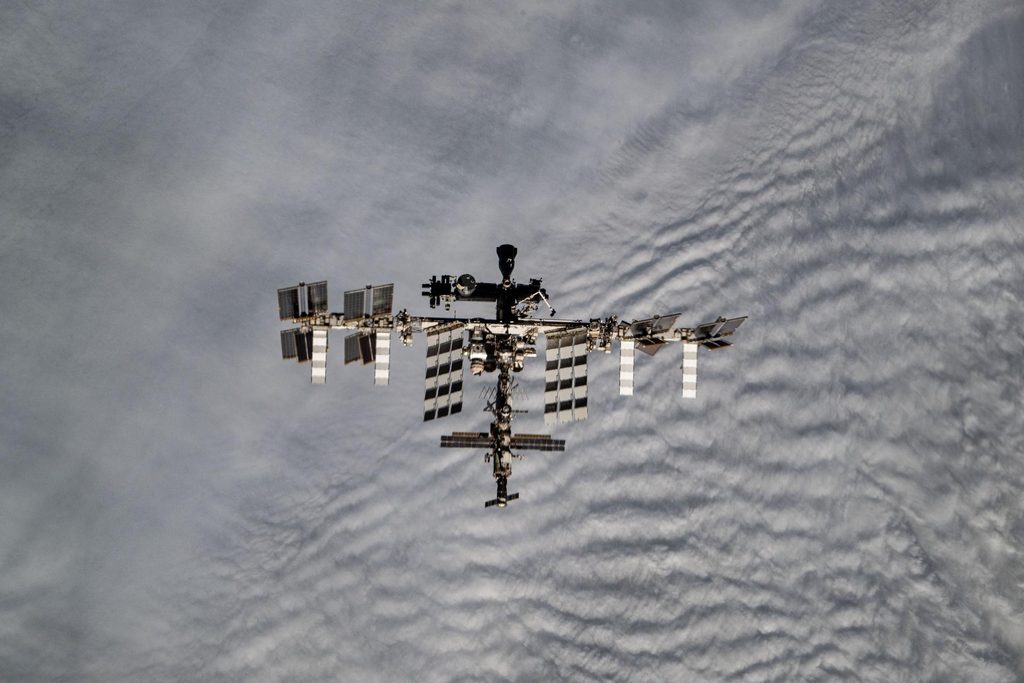
Cargo Dragon is the only station resupply ship that comes home intact. Cygnus, Progress and Japan’s HTV-X all burn up at the end of their missions. That makes Dragon NASA’s main way to bring science, failed parts and spacesuits back to Earth.
This week shows how much that matters. Northrop Grumman’s Cygnus XL left the station Friday and is due to be destroyed during reentry today. Dragon’s return leg, by contrast, will carry back a robotic arm joint, a spacesuit and life-support parts for refurbishment.
The two launches also put SpaceX’s reuse model in plain view. One booster is going for its 20th flight. Another, on its eighth, will deliver hardware that keeps a long-serving station healthy.
Meanwhile, in South Texas
Starship is quieter this week but still moving. Ship 40, which splashed down intact on Flight 13 in July, arrived at the Port of Brownsville on Oct. 7 after 75 days at sea, NASASpaceflight reported. SpaceX hasn’t said what it will do with the vehicle.
NASASpaceflight also reported that SpaceX pulled the engines from Ship 42 and sent it back for more cryogenic proof testing. FAA planning slides list Starship Flight 15 no earlier than Nov. 8. SpaceX itself hasn’t announced a date.
What to Watch Next
- Tonight, 6–10 p.m. CT: Starlink from Vandenberg and the booster’s 20th landing.
- Tuesday, 5:33 a.m. CT: CRS-35 liftoff and a Landing Zone 40 touchdown.
- Thursday, about 10 a.m. CT: Dragon docks to Harmony’s space-facing port.
- Thursday evening: USSF-481 from Vandenberg. SpaceX lists a window of 6:44 to 10:44 p.m. CT.
- The new arrays: Watch for NASA to schedule spacewalks to install the final iROSAs.
If everything holds, SpaceX could fly three Falcon 9 missions from two coasts before the weekend.



