

SpaceX put a Cargo Dragon on a dawn track to the International Space Station this morning. Falcon 9 lifted off on time at 5:33 a.m. CT Tuesday, Oct. 13, from Space Launch Complex 40 at Cape Canaveral Space Force Station in Florida.
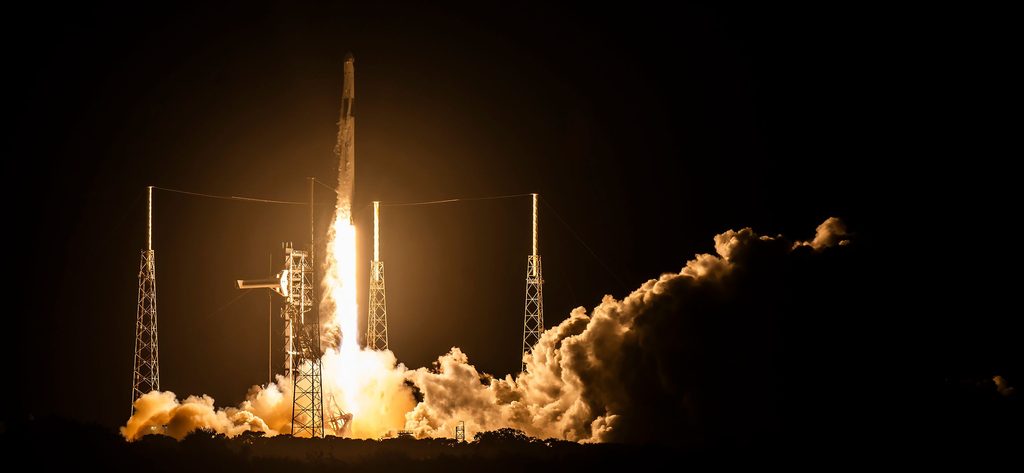
The flight is NASA’s CRS-35 mission — SpaceX’s 35th commercial resupply under the CRS-2 contract. SpaceX summed it up in two words on X: “Liftoff!” Minutes later the company confirmed the first stage had stuck the landing at Landing Zone 40. Dragon separation followed, and the capsule is now on its own for a Thursday docking.
Along the East Coast, skywatchers from Florida into Georgia caught a sunlit “jellyfish” plume as the exhaust met the rising sun. Local and social coverage of the dawn show was widespread. The science aboard is quieter, but it may matter longer.
Right on Time in an Instantaneous Window
Commercial station flights do not get long open windows. CRS-35 had an instantaneous opportunity, and SpaceX hit it. NASA put liftoff at 6:33 a.m. EDT. Local report from Talk of Titusville pegged it near 6:33:44 a.m. EDT.
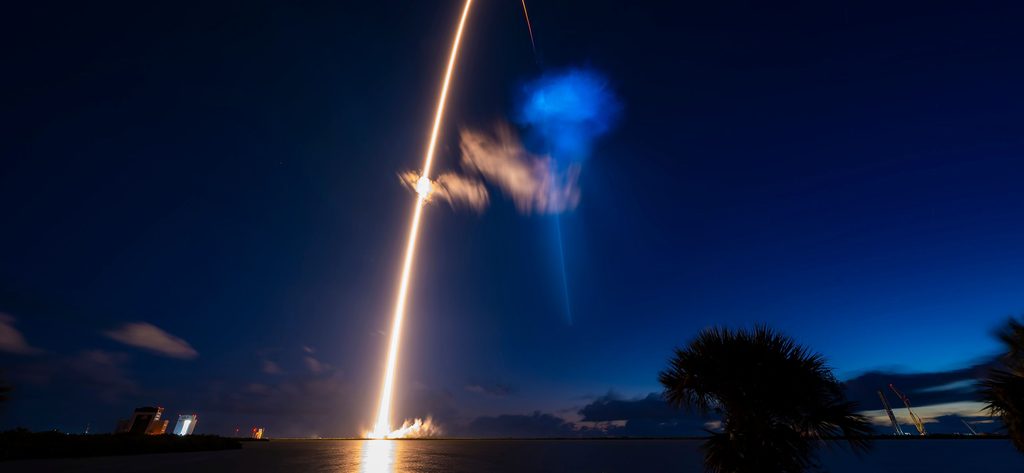
That timing mattered beyond the pad clock. A dawn plume lights up when the rocket climbs into sunlight while the ground is still dark. SpaceX later posted launch stills of the pad ascent and the high-altitude glow that lit phones from the Space Coast northward.
The company also posted a clean status line after stage separation: “Dragon separation confirmed. Autonomous docking with the @Space_Station on Thursday, October 15 at ~11:00 a.m. ET.” In Central Time, that is about 10:00 a.m. CT. NASA will stream rendezvous and docking coverage beginning at 8:15 a.m. CT Thursday.
Veteran Hardware, Eighth Landing at LZ-40
Both vehicles on this flight have flown before. SpaceX says this is the fourth flight for the Dragon spacecraft supporting CRS-35. It previously flew CRS-26, CRS-29 and CRS-33. Spaceflight Now identifies the capsule as C211.
The first stage is on its eighth flight. SpaceX lists its prior missions as KF-01, IMAP, NROL-77, GPS III-9, CRS-34, NROL-95 and one Starlink flight. After stage separation, the booster flipped, burned and landed at Landing Zone 40 at Cape Canaveral Space Force Station.
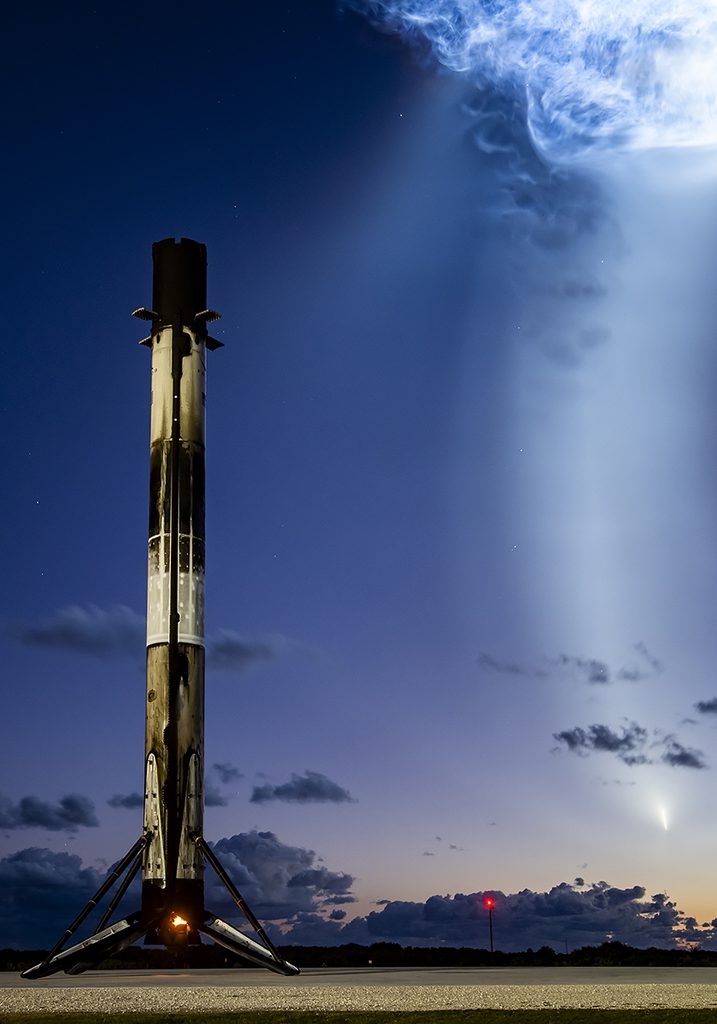
“Falcon 9 lands on Landing Zone 40,” SpaceX posted. A follow-up post underlined the same point: “The first stage booster supporting CRS-35 returned to Earth and landed at Landing Zone 40.” Another said simply, “Falcon 9 launches the CRS-35 mission to the @Space_Station.”
An LZ-40 landing keeps recovery closer to home than a droneship — a familiar final act on this East Coast cargo track.
Why the Final iROSA Pair Matters
NASA says Dragon is carrying more than 6,300 pounds of supplies and hardware. The headline cargo is the final pair of International Space Station Roll-Out Solar Arrays, or iROSAs.
NASA’s mission overview frames those arrays clearly. They will complete the augmentation of the station’s power system “to support critical operations, including its safe and controlled deorbit.” Astronauts will install them on spacewalks planned for later this fall, NASA’s post-launch news release says.
That line is easy to skim past. It should not be. The station is still a busy laboratory, and NASA is also planning a safe, controlled departure when operations end. More power helps research today and disposal later. Completing the iROSA set is both a science story and an end-of-life engineering story.
There is a neat loop in C211’s logbook. On its first flight, CRS-26 in November 2022, this same Dragon carried an earlier iROSA pair. Now it is delivering what NASA calls the final pair.
Science That Comes Home
The rest of the manifest leans hard into biology and materials. NASA’s overview names the experiments.
LambdaVision-1 is testing how to manufacture artificial eye retinas in microgravity, building them one thin layer at a time. Reduced settling in space may create more uniform layers. The goal is better implants for patients with currently incurable retinal diseases on Earth.
Stellar Spheroids studies how microgravity affects the growth and function of 3D human heart tissue models. Researchers want to know whether space helps form better vascular networks. Results could feed more realistic heart models for disease research and larger-scale drug testing on future missions.
ELF-Unconventional Glass 2 watches how glass forms in microgravity from non-traditional elements. Molten samples will be observed in orbit, then returned for ground analysis. NASA says those glasses could offer higher strength, better optics and more durability for spacecraft and habitats.
MINDS studies brain organoids — “organoid villages” that combine cells from multiple people — to better understand inflammation tied to neurodegenerative disease. NASA lists Alzheimer’s, Parkinson’s and multiple sclerosis among the targets.
Cargo Dragon is still the only U.S. station freighter that comes home intact. Progress, Cygnus and Japan’s HTV-X burn up. That return path is why time-critical research rides with SpaceX. NASA says Dragon should stay until mid-November, then splash down off California with research and cargo.
Other hardware looks ahead, too. NASA is flying a collapsible contingency urinal demonstration for Artemis III. An empty foam clamshell is riding up so a failed Canadarm2 joint, swapped out during a June 30 spacewalk, can ride home for analysis.
Docking Watch and the Week’s Context
After about a 52-hour chase, Dragon will dock on its own to the space-facing port of the Harmony module. NASA astronaut Anil Menon and Canadian Space Agency astronaut Joshua Kutryk will monitor the arrival from the station, NASA says.
The docking window sits in a busy stretch for SpaceX. On Monday evening, Oct. 12, The Space Tap previewed this Florida dawn flight alongside Starlink 15-25 from Vandenberg — 27 satellites at 7:28 p.m. CT, booster B1088 on its 20th flight, droneship recovery on Of Course I Still Love You. CRS-35 was always the heavier story: new station power and research that can come home.
What to Watch Next
- Thursday, about 10:00 a.m. CT: Autonomous docking to Harmony’s zenith port. NASA coverage starts at 8:15 a.m. CT.
- Later this fall: Spacewalks to install the final iROSA pair.
- Mid-November: Dragon undocks and aims for a California splashdown with return cargo.
- Starbase outlook: Elon Musk has recently put a Starship Flight 15 ship-catch attempt roughly four to six weeks out, around the stretch before Thanksgiving. That is not a firm official date, and planning slides can move. Treat it as a watch item, not a countdown.
For now, the hard part is done. Falcon 9 flew. The booster came home to LZ-40. Dragon is free and chasing the station with the last iROSA wings — and experiments that only make sense if they can come back.



